
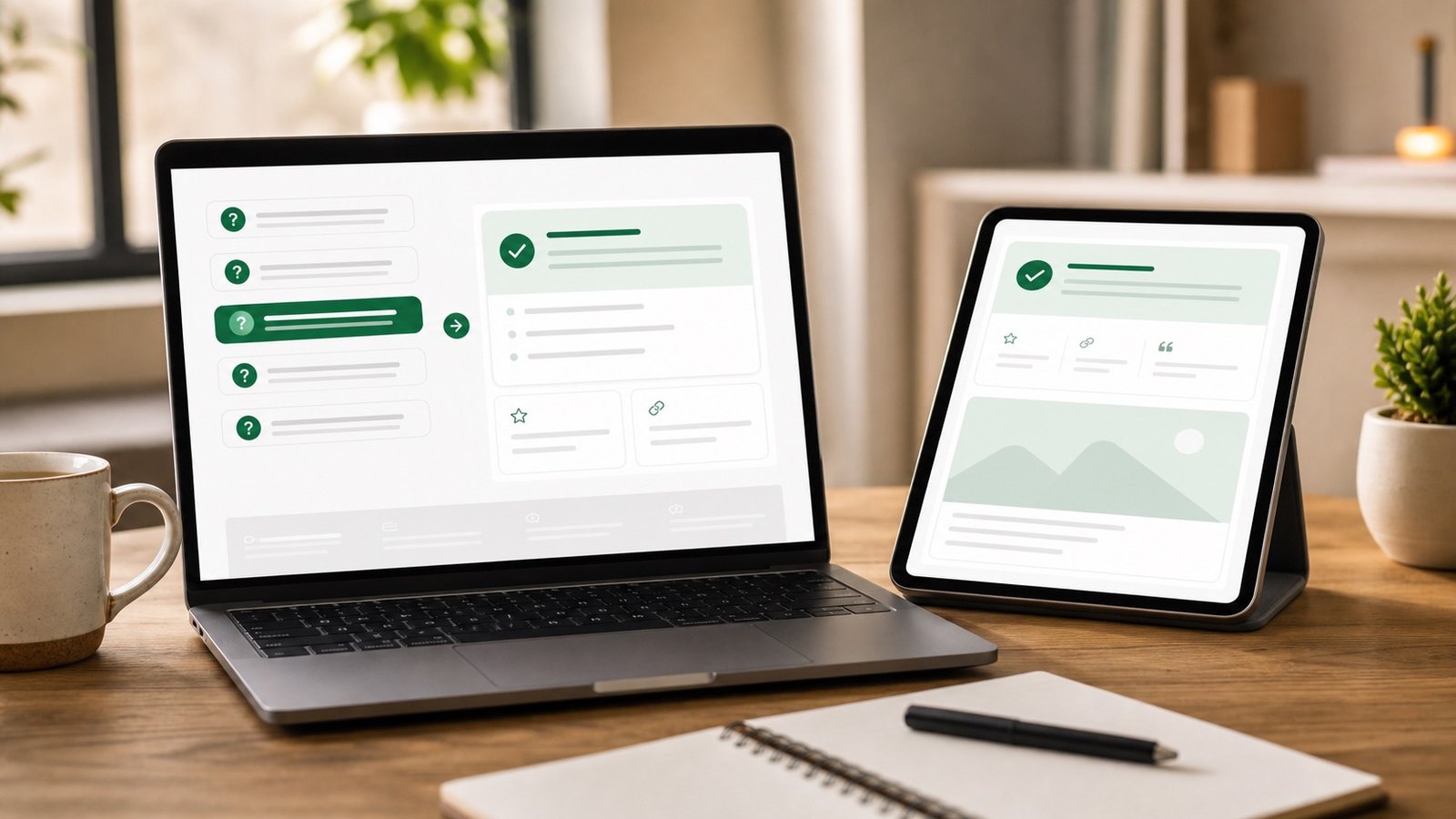
What AEO means
Answer Engine Optimization, usually shortened to AEO, is the practice of making website content easier to use when someone asks a direct question. It applies to traditional search features, answer boxes, AI-assisted search experiences, voice-style queries, website assistants, and any interface where a user expects a clear answer instead of a long list of pages.
AEO is not a replacement for SEO. It depends on the same basics: crawlable pages, useful content, accurate titles, descriptive headings, internal links, accessible markup, and a fast enough user experience. The difference is emphasis. SEO often starts with page visibility. AEO starts with the question a customer is trying to answer.
For a service business, useful AEO work might answer questions like: How much does website design cost? Do I need WordPress? What is GEO? What does a cookie consent banner do? Can a website collect leads into a dashboard? The answer should be direct enough to help quickly, then deep enough to support a real decision.
Start with customer questions, not keyword lists
AEO begins by collecting real questions. Sales calls, contact forms, support requests, Ask Greenhouse logs, search queries, chat transcripts, and customer emails are often better sources than generic keyword tools. The best questions reveal hesitation, confusion, urgency, or comparison. They show what a visitor needs before taking the next step.
A practical AEO map groups questions by intent. Some questions are informational, such as what a service includes. Some are commercial, such as price, timeline, platform choice, or provider comparison. Some are operational, such as what happens after a form is submitted or how cookie consent works. A strong page structure answers each type in the right place.
The goal is not to publish hundreds of thin FAQ pages. It is to improve the pages that matter most. A service page should answer the obvious pre-sale questions. A blog post should explore one topic deeply. A FAQ should clarify repeated points without replacing the richer explanation around it.
Write direct answers before deeper explanation
Answer-focused content works best when the first answer is easy to find. A section can open with a concise answer in one or two sentences, then expand with examples, limits, process, and next steps. This structure helps impatient readers, search systems, and website assistants. It also makes content easier to quote accurately because the page contains a clean answer near the relevant heading.
For example, a section about custom HTML websites should first explain when they make sense. Then it can compare maintenance, security, speed, editing workflow, cost, and ownership. A section about cookie consent should first explain why optional tracking needs clear choices, then describe categories, logs, and script blocking.
Avoid vague phrases that sound polished but say little. AEO rewards clarity. If the business has a process, describe it. If cost depends on scope, name the factors. If a claim has limits, state them. If a service is not guaranteed, say that plainly.
Use headings as a question-and-answer map
Headings are not decoration. They are the map of the page. A visitor should be able to scan the headings and understand what decisions the page helps with. Search systems and assistive technologies also use headings to interpret structure. For AEO, headings should be specific enough to stand on their own.
Useful headings often include the subject and the decision. Instead of “Our Process,” a page might use “How a website design project moves from audit to launch.” Instead of “Features,” a page might use “Custom website features that support leads and reporting.” This does not mean every heading must be a full question, but it should make the answer clear.
Good headings also prevent content from becoming a single broad essay. They break the page into answerable sections that can be reused in search snippets, assistant responses, internal links, and visitor scanning.
Schema can help, but it is not magic
Structured data can help search engines understand eligible content, but it should represent what visitors can see on the page. Google’s structured data guidelines are clear that markup should not describe hidden, misleading, irrelevant, or inaccurate content. Schema should support the page, not create a second version of it.
For AEO, useful schema may include Article, BlogPosting, Organization, BreadcrumbList, FAQPage when the FAQ is visible, Service where appropriate, and local business information when it accurately applies. The choice depends on the page. More schema is not automatically better. Accurate schema is better.
The same principle applies to website assistants. If Ask Greenhouse or another site feature uses structured site knowledge, the knowledge should match visible content and current services. AEO fails when the website says one thing, the assistant says another, and the business actually does a third.
Build internal links around the next question
AEO-friendly pages should anticipate what the visitor will ask next. Someone reading about Answer Engine Optimization may also need the broader SEO service page, the separate GEO article, a website strategy guide, or a contact path. Internal links should connect those natural next steps.
This is why related reading blocks matter. They help visitors move from one answer to the next without starting over. They also help search systems understand topic relationships across the site. A page about website design should link to responsive design, lead generation features, custom modules, and SEO planning when those topics support the decision.
Internal links should be descriptive. “Read the GEO guide” is more useful than “click here.” The link text should tell both the visitor and the system what the destination explains.
Measure whether answers create better actions
AEO should be measured by more than impressions. Useful signs include better-qualified form submissions, fewer repetitive pre-sale questions, more clicks from blog posts to service pages, stronger engagement with FAQ sections, and clearer Ask Greenhouse interactions. If visitors keep asking the same unanswered question, the page needs work.
Search Console, analytics, dashboard logs, form submissions, and sales feedback all show different parts of the picture. The best AEO process reviews those signals together. Update pages when services change, when customer questions shift, or when an answer is too vague to help.
The simplest test is human: can a potential customer quickly understand the answer and decide what to do next? If yes, the content is doing the work AEO is meant to support.
Helpful references
- Google Search Central SEO Starter Guide
- Google structured data guidelines
- Google guidance on helpful, reliable, people-first content
For more planning context, continue with Generative Engine Optimization for Business Websites and AEO, GEO, and SEO for Business Websites.